
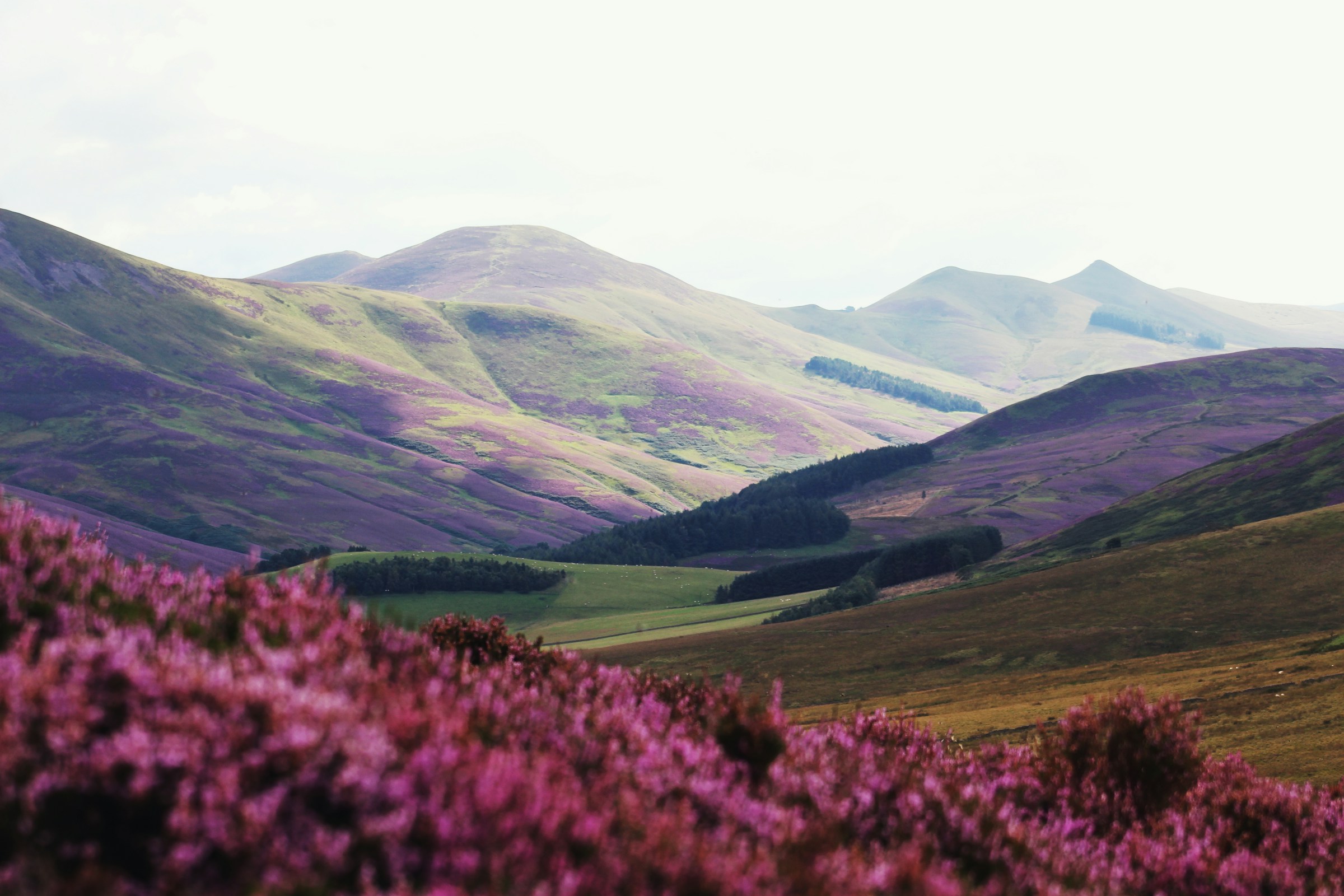
Where: Origin & it can be foraged.
Origin: Heather is as symbolic of Scotland as the thistle is. Recorded as early as 1399, hader and heddir are Old Scottish, which was eventually altered to heather in the 18th century to resonate with the English word heath, meaning open or uncultivated land – much like the Scottish Highlands where Heather grows.
Heather is abundant across the boggy moorlands, peat bogs, and rocky highlands of the British Isles. It thrives in acidic, nutrient-poor soil and it’s stubborn resilience has defined the rugged topography of Scotland since antiquity.
In the Dell: Pockets of deep purple heather cascade down the higher slopes of the Pentland Hills during the summer. Heather is so abundant around the Pentland foothills that most have no trouble finding it. You can easily clip the fresh, purple-flowered tips during peak bloom. The older, woody stalks and roots should be left untouched.
Why: How was Heather used traditionally?
Traditional Uses & Values: Heather is an ancient part of Celtic and Scottish lore. White heather was prized as a powerful talisman of rare good fortune and protection, while the abundant purple blooms represented Scotland’s rugged beauty of the wild; the kind that inspired Sir Walter Scott’s novels.
In the 16th century, herbalists (including John Gerard and Nicholas Culpeper) are recorded as using the “highland healer” as a remedy for a “weak stomach” and to “dispel melancholy vapours from the brain”.
Modern research has found that heather blossoms are rich in active polyphenols, arbutin compounds, and organic antioxidants known for their soothing, anti-inflammatory qualities. Brewed into teas and ointments have traditionally been used to treat coughs, arthritis, and rheumatism.
Flavour & Aroma: The heady perfume of Heather is obvious from the outset. The blossoms on their own are intensely floral; when extracted into an alcoholic spirit, the notes are sweet like highland honey, and reminiscent of dried lavender, chamomile and a subtle, tea-like earthiness. The finish of Heather helps to balance the heavier pine and citrus notes found in gin.
How it feels: The notes are deep, floral, soothing, and grounding; the mouthfeel is remarkably soft and velvety. While the top notes carry the sweet, wild perfume of summer honey and pollen, there is a complementary, dry flint-like undertone that anchors the flavours together beautifully.
“Healther has a sweet and perfume aroma that instantly takes me somewhere peaceful. It’s complex, and savoury, so draws me into a hint of lavender and camomile. While it’s qunticentially Scottish, the way it evokes a garden tranquilty is universal” — Ian: Dell & Dial co-founder.
How we use Heather
Heather is a rich, complex flavour that requires a careful touch so it does not overpower the brighter citrus elements of the spirit. In our summer gin, it forms the deep, aromatic body of the gin, providing helping to build the picture of the rolling hills of the Pentlands, descending into Colinton Village.
The best pairing with Heather leans into its natural, rich earthiness while cutting through the honeyed weight. We recommend a garnish of fresh rosemary or a twist of pink grapefruit peel to complement the heather’s subtle tannic notes and allow its wild, sunny warmth to shine.